Thursday, October 22, 2015

Heads Up - The Machine; A New Book From Justin Roff Marsh

I'm a great admirer of JRM so I got he's OK to share this with you.

"Update: The Machine (it's here!)
Orion
Can you believe it?
After many years of toil, The Machine is finally available for purchase!
You can get it on Amazon (hardcover or Kindle) and in all Barnes and Noble stores (physical and online), as well as in most US bookstores (including many airport booksellers).
Here's an Amazon link: http://bit.ly/Buy-The-Machine
If you haven't purchased your copy yet, please do yourself a favor!
And if you're one of the lucky ones who got your copy early, please hurry up and finish it and post a frank and open review on Amazon.
I'm now hard at work on a 6-class video short course. This course is entitled Beyond The Machine. It's enormous in scope, and it's FREE (as in Free Beer) for everyone who purchases The Machine (check the end of Chapter 1).
Thank you, again, to everyone who has shared support and ideas over the last few years.
Now, go read the book!
Justin"

If you want to stay updated with this kind of news and much more - please subscribe.

Monday, October 19, 2015

2015 TOCICO Conference - Final Thoughts

So, I've already written several posts about the learning that went on in Cape Town this past September (see here, here and here) and I guess it's time to move on. Still I want to leave you with a real taste for more and hopefully next time you'll come join us (see the TOCICO calendar for upcoming events near you). This review did not include my sessions and I will share some of that material separately in a future time. It's on my list.

For this final post I chose to review  2 sessions that I found had a high impact on me:

I have already mentioned Rami Goldratt's keynote on forecasting here. He talks about the fact forecasting capabilities in retail are not improving. In fact, they are deteriorating. It is becoming harder and harder to generate predictions that will create good enough forecasts so as to lead to the right decisions. No one is expecting a forecast system to be able to predict accurately what will shop X sell next Tuesday. But the fact of the matter is these forecasts fail at much simpler questions such as how much of product Y will be sold by the entire network over the entire season. This is a simpler question as it is an aggregation, allowing for mistakes to average out.

Rami presented 3 major forces that are eroding the ability for forecast:
1 - Customers are increasingly requiring products to create the exact fit for their needs and tastes. As a result manufacturers and retailers increase their variety. Think of toothpaste, just as an example. It used to be that you were either a Crest user or a Colgate (or another brand). Now each brand has an extensive range of options - different tastes, different usages and problem resolution and many of the possible combinations of these. As the variety grows the volume per SKU shrinks and with it the ability to predict. At the same time the customers learn to expect even more accurate fit and it is clear there is a feedback loop making the situation grow more and more extreme.
Gateway Supermarket Sardines' Section (from Wikipedia)
2 - Customer tolerance time is getting shorter, meaning retailers lose more sales when the exact inventory is not on hand. For example, in a market research Rami cited, people stated that they will pay a higher premium for immediacy that for technological improvement. As a result there is pressure to hold more inventory at the point of sales.
3 - The product life cycle is getting shorter. Customers are forever expecting new products and so there is a on going pressure on NPIs. New products do not have a history we can use for predictions and they have a major impact on the sales of current products (that have a high level of inventory in the shops from item#2) thus practically eliminating the ability to forecast.
On top of all this (as if that was not enough) more and more industries suffer from a product life cycle that is shorter than the supply time.
With all these phenomenas increasing over time, relying on forecasts will lead companies to fail. What we need is a system to minimize the time needed for reading and understanding the signals from the shop floor and to react to them fast. We have the needed IT, we are just using it the wrong way.
Just so you know, Rami promised a video covering all this in more detail - Rami, we are waiting.

The second talk was by Dr. Alan Barnard concentrating on flow. Re-reading Dr. Goldratt's "Standing on the Shoulders of Giants", Alan pointed out that the 5 Focusing Steps are actually an application and should only be used when the boundary conditions dim them relevant. Instead he suggest starting with the concept and principals of flow:
1 - The prime objective of operations is to focus on flow, specifically on reducing flow time.
2 - This objective is to be translated into a practical mechanism that guides operations when not to produce.
3 - Local efficiencies must be abolished.
4 - A focusing process to balance flow must be in place.

The application of these principals will be:
1- Separate work and time buffer.
2 - Aggregate time buffers.
3 - Remove unnecessary buffers
4 - Simplify flow with a single time buffer.
Looking over these lists it is clear that the 5 Focusing Steps, which are used for constraint or bottleneck management, are only relevant when those are the primary causes of blocks to the flow.

This is just the tip of the iceberg, of course. I highly recommend getting access to the conference videos for these sessions, if you weren't there.

If you enjoyed this and want to learn more - share it and subscribe to this blog, great things are coming.


Monday, October 12, 2015

2015 TOCICO Conference - Catch Phrases

Every TOC event I go to blesses me with a lot of new knowledge and ideas. It also adds some 1-liners and catch phrases. When I capture them here, in the blog, not only can you all enjoy them with me, I can also recall them years later and put them to use (like the ones here). So, here are some of the things I collected during the 2015 Annual TOCICO conference:

  • "War Room" - don't talk about yesterday (to the 3rd point after the decimal), talk about tomorrow!
  • Fear of the unknown drives us to act according to detailed (and mistaken) forecasts.
  • Sales comply with Pareto Law, inventory does not.
  • The bigger the range, the bigger the tail.
  • People claim (as in "market research shows") they are willing to pay a bigger premium for instantaniety than for technological improvement.
  • In fashion, the product life cycle is shorter than the supply time.
  • Any business based on forecast is fragile (refer to my previous post on anti-fragile)
  • Orthodoxy - anything done without knowing why.
  • IVD (Inventory Value Days - what do you know, some countries don't use the UD$ currency, go figure) = stuck, unworking capital (you knew that).
  • Risk is uncertainty against an objective
  • Risk management should be applied on the weakest link.
  • Start with Flow - before applying 5 Focusing Steps check that the constraint is the real cause of delays/blocks in flow.
  • Operational Goal - meet demand (at peak, not just on average) effectively and efficiently.
  • If you are not testing what you are thinking - you are not thinking like a scientist.
  • A cluttered mind is an obstacle to thinking.
  • The indicators must subordinate to the goal.
  • The goal and the necessary conditions must measure alignment as well as progress.
  • Variability in the #1 enemy of flow.
  • We need simple systems that can handle complexity.
  • Systems are variability amplifiers.
  • Forecasts are valuable for mid to long term planning, not day-to-day operations.
  • Incoming "Peaks" are not forecasts.
  • Buffers decouple supply and demand.
  • Come your customer from will, not from need, you can not create trust when you are needy.
  • Strategy - a project portfolio of things that need to be done by the time we are planning for.
  • It is management's responsibility to create the automatic machine.
So, which one is your favorite? Please share.

Let me know if there is any point you feel needs more elaboration.

Monday, October 5, 2015

Working with Intuition - The 2016 Odyssey Program Exercise

In the first part of my thinking backwards exercise I figured out what will make for a successful TOC Odyssey training. So the next step should be to keep working backwards and highlight the actions that need to be taken for these results to unfold.Logical, right?

Well, yes and no.

If you recall, I left the plan hanging at:
My first inclination was to go backwards to:
Then I got thinking.

It seems trivial. In TOC TP we call such trivialities "Oxygen". Since oxygen is always needed for human activity it is not necessary to state it in the logic diagram. Everybody knows it and it does not add information for our analysis. Oxygen statements should be handled with care. The mere fact something came up as an idea should be an indication that a double-check is in order, as one would rarely consider the need for oxygen under normal circumstances. In other words, the fact we have been thinking of the need for oxygen may point out that the conditions are not standard and this should be accounted for,

OK, so the fact that everybody should be in the room for the session to start could be an oxygen fact. It seems very logical, everybody should know this without me telling them, clearly there will be earlier steps that will take care of attendance. I should skip this step, it is redundant.

Or is it? I was stuck in a loop for some time, pondering this, wondering what is going on - why am I still thinking about this point after I figured it out? 

Well, turns out it was my intuition guiding me to a spot I missed. It is not enough to have a full enrollment. Life happens and we will surely have a few last minute cancellations. I know all our registrants will loath missing the session, but sometimes you just can't help it. So, if I want the session to be a real hit and create real value for all, I need to take care of this point and this is just the right place in my plan to inject a place holder for the results of those actions. Makes sense?

Here is what I came up with - In order to have a good kick of we need:

Which will happen if these prior steps happen (remember, we are in reverse order, the top box will happen after the bottom):
All graphics were done using Flying Logic
Well, I actually reached a task. It is going to be located very far into the future of this "project", of course and I expect to find it has some predecessors, but it is still exiting to move to that practical part. 

Next step will be to keep working from the definition of success back to the tasks that need to be done. I am expecting this will no longer be linear and I will be working on parallel tracks soon. Stay tuned and let me know if you have any ideas for making the Odyssey a hit.


Tuesday, September 29, 2015

Thinking Backwards - The 2016 Odyssey Program Exercise

So, if you remember my last post I suggested we need to prepare our mental muscles for the hard labour of TP and one of the exercises I suggested was thinking backwards. Now, this is not the TP's transition tree, which is also constructed backwards. It is also not the usual managerial focus of let's plan with the end in mind, which usually ends up being a forward construciton exercise. It's a free formed process that starts at the end and moves forward by imagining a probable route.

Here I will share the results of my recent use of this process. I have volunteered to make the 2016 TOC Odyssey happen. It will be in Jaffa during the first weeks of April, 2016 (Save the dates - April 3-7 for the Freshman session, April 10-13 for the Alumni, dates are currently estimates). It is my wish to make this session a big success - fun, enriching and enlightning for everyone. To make this happen I am starting out with thinking backwards (as suggested in Purple Curve Effect by Jeff Kinsey - see my book review here) to see what I can learn from it,

First of - my goal, the end result:
Can I imagine how reaching this goal would feel? yes, I can, right down to that pleased-embarrased feeling as everybody claps. This is a big issue, a lot of times I start this exercise and realise I have no clue what the end result looks and feels like. Just try this out right now - is there a change you would like to do in your life? lose some weight? go to bed earlier? spend more time with someone? learn something? OK, that's great. Now - can you imagine vividly, in your mind's eyes, the end point scene? what will you wear, say, feel, do?

So, I can see this goal coming to life. Great! Now what? Well, what could have or should have happened before that to make it possible? What was the step before the goal? Here is my answer:
Can I imagine achieving this milestone? again I can, I can even hear Alan Barnard's distinct accent as he tells me how much he enjoyed leading the session. Great! Now ask again - How did that happpen? What could have happened before that? Basically we are looking for possible causes to create the wanted effect.

And so I get on a backward roll:


All graphics were done using Flying Logic
So far, so good. This is where I got a bit sidetracked, as this is the stage where several predessessors converge. It is also where I move from reaping the future results to defining the work that needs to be done in order to make it happen. So this exercise seems to have been quite un-productive so far, doesn't it? Well, that's not true. This part has made it clear that this is a very just cause, quite worthy of my investment. Now I am really motivated to make the 2016 Odyssey one to be remembered! 

Next step - to take the next leg of down the future memory lane - what did I do to make it happen? Check out what happened here!


Wednesday, September 23, 2015

Building The Clear Thinking Skill

After my presentation on the 6 Questions of Technology (yes, I will share more on this) at the TOCICO Conference, one of the people in the audience came up to me and said how happy he was with the work model we suggested, until the trees came out. They are so hard to construct, he said. I could hear the despair. I could also understand it and relate to it. The TOC TP are a set of highly potent tools, of course but they are very hard for many (present company totally included) to use.

This week I started testing out a new point of view I had been thinking of since my trip to S. Africa - problems are just opportunities in the rough (and yes, I will share more on this as well, you really have a lot of great things to come back to this blog for). As a result I had given my self several mind games and exercises to work on. Then it dawned on me - just like we wouldn't expect anyone to run a marathon before the have run several shorter distances in the weeks and months leading to the race, why should we expect people to take on TP without first building up to them through mind clearing workouts?
You wouldn't be doing this the first day of your workout program, would you? (Source - Wikipedia)

My point is that many of us are not used to thinking about things the way that is required by the TP. While we spend our lives thinking, we are still not trained to the level TP requires. It is very similar in yoga where although you have breathed all your life, you are not trained to breath the way yoga demands and you have to learn and practice it. So, it may be that before we venture into logic trees we have to build our brain muscles with easier exercises to prepare us for it.

Now, this is just a theory and I don't have a progression of exercises mapped out, just a few preliminary ideas. So I really need you help and inputs.

Here are the exercises ideas I already have and have been practicing:

  1. Beginner - learn to ignore all or nothing thinking by creating a 100 list - think of a block that you feel is in your way to achieve something then create a list with 100 things you can do to achieve it despite the block (so if you feel you can't get a good job because you don't have enough experience in your resume, then think of 100 ways to make you noticeable to recruiters in and out of your resume). I managed about 30 ideas in the first 24 hours and got to 44 on the second day. Once you are at 50, I suggest you start acting while keeping the list going until you get to the 100 mark, don't use it as an excuse.
  2. Intermediate - clear your thinking from emotions by putting yourself in places where you are uncomfortable, like not reacting to a question by your spouse when that question is "illegal" - e.g. asking you what your kid's preferences are when said child is present. The idea is not to to stop you from feeling but to help you separate your thoughts about what needs to be done from your emotions about a situation.
  3. Advanced - practice result oriented thinking by mapping a process backwards - think of an interaction you are planning to have and then map it from the desired end state back to the beginning. So first you must figure out how you want that interaction to end at a level you can visualize it. This means you have to take your goal or desired outcome and turn it into a concrete result (say I want my adult kid to move out, my end state visual would be of her saying "You know what, mom, I'll get my own place within the month"). Now figure out and visualize what had to happen just prior to that (perhaps she said "Staying with you and Dad isn't good for me, it doesn't help me become a capable adult"). Credit to this exercise goes to Jeff "SKI" Kinsey and his book "Purple Curve Effect" I covered in this review.
I'll update you if I get new workout ideas. 

Let me know what you think - will it make any difference if we address the TP tools more gradually? What else can and should we try?

Sunday, September 20, 2015

2015 TOCICO Conference - Anti Fragility

This is the second post in a series. For the first post - go here.

A main theme in the conference was Anti-Fragility, becoming anti-fragile as individuals and a community and helping companies become anti-fragile. I have heard the term before but this time I feel I got a much better grasp of it. Here's what I can share:

  • Definitions:
    • Fragile:
      • Sign on the box will say "Handle With Care"
      • Mythological prototype is Damocles with the sword above his head ready to drop when his life is at its best
      • Features limited gain and unlimited pain
      • Breaks in reaction to pain
Richard Westall's Sword of Damocles (Source:Wikipidia)
    • Robust:
      • Sign on the box will say nothing, as it doesn't make a difference
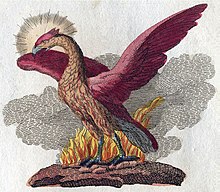
      • Mythological prototype is the Phoenix which comes back from the ashes just as it was
      • Features limited gain and limited pain
      • Recovers in reaction to pain

 FJ Bertuch's Phoenix (Source: Wikipedia)

    • Anti-Fragile:
      • Sign on the box will say "Please Kick"
      • Mythological prototype is the Hydra which grows 2 new heads for every 1 cut off
      • Features unlimited gain and limited pain
      • Grows in reaction to pain
Hercules Killing the Lernean Hydra
(Source: Wikimedia Commons)
Anti-fragile systems are designed around multiple low risk experiments, with the ability to quickly focus and cash in on the few successes, letting go of those experiments that did not make the grade. This is a system that does not protect all of its parts.

Now, of course, it is clear that the anti-fragile state is relative, time-based and specific. Think of the human body - our bones are quite anti-fragile, recovering to be stronger at the break point, but our necks and hearts are not, bearing the burden of past trauma, if they ever recover.....

While the subject was a repeating thred there weren't much ideas as to how to make it happen, One thing was made very clear, though, throughout the conference and that is that systems that are based on forecasts are fragile, more will come on that.

So, take a moment to reflect about your private life, your organization, our community - where are they now? how can this be improved? at what cost? 

Let me know what you think.

Friday, September 18, 2015

Book Review - Purple Curve Effect

Almost finished reading this book. I like it, though I can't think of anyone I'd recommend it to. For the begginers it is way all over the place and would not be a good starting place. For the advanced it is way too simplistic. Still, SKI is very personable and does a good job selling himself.
I liked some of his tips, especialy the idea of making lists from the end goal backwards. I was also very intrigued by the fact that I think he got all his TOC on backwards and still it works very well for him. Goes to show this TOC thing is robust.

2015 TOCICO International Conference - Cape Town

I've just returned from Cape Town a week ago and I think it's a great time to share some of my conference highlights with those who could not make it this year.
Some Conference Participants (can you spot me?)

First off - join me in sending love and support to Marcia Hutchinson, TOCICO's General Manager, who broke her arm on the first night and needed an operation. Marcia's proffesional management was totally aparent in the fact the conference went on without any interference, leaving her free to take care of herself. GET WELL SOON, MARCIA!

The first day was a full day of keynote speakers interlacing academics and practitioners  and introducing the conference's main thread of the Anti-Fragile vision. Some success stories brought to light the amazing effects TOC can have on a business and how important it is to ensure the process is maintained over time and management switch-overs.
Keynote Speaker

I especially liked Rami Goldratt's session about the forces eroding our ability to generate forcasts, especially in a retail environment. He makes a valid point - yes, forecasts are inherntly wrong but they should be getting closed and closer to being right. After all, they are based on past experiance, of which we have more and more data points with each day passing, on computing abilities, which grow bigger and faster with each day passing and on algorithms, that should improve over time and experiance. Look at the weather forcast as an example. Over the years it has gotten better, to the point that we trust the 10-day forcast as a good enough directive for packing before a trip. Sure, we do not expect it to be right on the money, just in the vicinity. Shouldn't the forcasts for sales numbers and for purchasing be doing the same? Well, they don't and Rami gave a very clear explenation why. He also promissed to put together a YouTube vid covering his explenation, so keep a look out.

With all the interesting take aways I've had, it seems a series of posts is in order, so be on the look out for my future posts on the subject. (Here is the first one)

Here is a sneak peak:
My presentation about buffering life
So, have a look at the conference schedule, and let me know what is of interest to you.

Wednesday, December 4, 2013

Order and Focus through Gmail Cleanup

A few days ago I noticed, again, that my unread count in Gmail is far greater than I would like. Noting that the count was only for my Inbox, not including the unread mails in the Social, Promotions and the other tabs I was using I knew the situation was much worse. Still, this was not the main problem. the main problem was that I was starring important To-Do items and then letting them slip as they were pushed to oblivion by new, unread mails. I needed to get Gmail to sort my mails in another order. I wanted my starred items on top. So I went into Settings and figured out a way to do it.

Here's how my Inbox is set up now:

  • First I have all items with "Calendar" label - I set up a rule to have all the auto-reminders from Google's Calendar directed automatically to that label without staying in my Inbox more that an instant. This is a tiny list as I delete anything's that in the past.
  • Next I have my starred list - this should be kept under 10 items at all times. If I go over 10 it means I must kick something off it by taking care of it immediately.
  • Then comes the unread list - this is currently still too long but I'm working on trimming it. I've already filed away quite a lot of the unread clutter using labels and deleted a lot too. I'm hoping to get it under 10 at all times as well.
  • Last is the rest of my inbox.
This order led me to admit I am getting far too much mails I really don't need. When I used the tabs method those mails didn't bother me. I'd go in to the non-Inbox tabs and run wholesale delete jobs 2-3 times a week and thought nothing of it. This new order made me start unsubscribing and cleaning up my act.

To clean up my unread list I have started reading all those blog posts and updates I have kept in order to read "later". It seems I've accumulated quite a few of "Dr. Lisa" Lang's blog posts, so now I am reading through them ad loving them, of course. The funny thing is Dr. Lisa talks a lot (and I do mean A LOT) about focus, and with the way I was running my mailbox that's the one thing I didn't have....

So, if you aren't subscribed to the Science of Business blog or the Velocity Scheduling System blog I highly recommend you subscribe to them. If you have any good tips for Inbox control - please share with us by commenting on this post.


Thursday, October 24, 2013

The Amazing Power of Clear Thinking

So I wasn't planning to write an update on my Logical Thinking class just yet, the next lesson will be tomorrow. Then tonight at dinner something great happened. My younger son, who is soon to be 9 years old and takes my class, saw me preparing the handout he asked for, the one with the logic tree we made last week (as I reported here). So he decided to make his own logic tree. Later I figured out he thought that was their homework, though I only asked for simple If..Then connections.

He sat down and started working on his tree, soon he asked me to review it. It was upside down and quite illogical. He had effects leading to causes, he had facts for effects instead, when trying to read it out using If...Then it made no sense and his statements did not abide any of the rules for writing correct statements. It didn't matter - not to him and not to me, though I did read it out loud to him and asked if he found it made sense, he did. I left it at that. Then he continued working on the tree. As he was working he said - this is a tree of my problem, it explains what is causing it.

I was astonished and very delighted at his ability to figure out, all on his own, that this logic tree thing is really useful and powerful. I think this is the result of the clarity of thinking you reach when using the tree as a guideline to thinking.

In her book "Thinking for a Change", Lisa Scheinkopf claims that learning the basic tools of logical thinking, sufficient cause and necessary condition, is enough. From there you can build everything on your own. I guess my boy proves her right.

Tune in soon to learn how lesson 2 turns out.

Dominoes and Root Causes

Have you ever asked yourself how can it be that the small changes TOC calls for can create such a significant reaction, I think I found the answer.

Now, don't get me wrong, I know those changes are extremely hard, but how can you call a change that costs no money and can be done in less than a week, such as changing priorities on the shop floor, anything but a small change? All the TOC solutions are based on these small changes - hold inventory at a different point in the supply chain, start doing things at a different time, change the way you plan, measure different things. These are not technology based solutions (as in "Buy this technology and all your problems will be solved", which we all know doesn't work out like that, ever) but solutions that sometimes need technological support. So the solution isn't based on investment, although it might sometimes be required. OK, I think you get my drift.

So how do they do it? Well, TOC talk and the TP talk are all about causality and using this causality to find the root cause of things. this means they are full of chains and chain reactions. This always remind me of dominoes and that's what led me to this clip:
At first I did not see any connection between this and the TOC chain reactions but then I realized this holds a very basic truth - it takes very little effort to start the chain reaction going and once started, each step releases all the energy stored in it, amplifying the effect. The amplification can sum up FAST. It also confirms what we all know, intuitively,that it's much harder to fix the big things at the end of the chain and much easier to fix the small things at the beginning, which is why TP has you looking for the root cause - the smallest domino. The only main difference from this dominoes example is that real life seems to recharge on it's own, at least partially. You do not have to pick up each and every domino in order to start a new chain reaction.

Do you think the physical explanation hold true for real life situations? please share your thoughts.

Sunday, October 20, 2013

"Elementary, My Dear Watson" - My First Logical Thinking Class

It's been ages since I've blogged here, I got caught up by a wicked current in the stream of life.... I'm hoping for a smoother sail in the coming future. Still, I had to share this with the people I knew would understand the most, my faithful readers.

I've started teaching a class about the Thinking Processes in my boys' school. It is a democratic school and the children choose which classes to attend. I have around 7 elementary school boys in my class, including my younger son. They are all, it seems to me, in 4th and 5th grades. Last Friday was our 3rd lesson and for the first time I could say it was a good one. Yep, I had a few false starts until I got the feel for my "customers". I have learnt the hard way that with this group I can't, at least at this time, teach them. I have to let them learn. If I stand there and talk to them, explaining my head off, they just get board. Since this is a democratic school they will then choose to stop attending the class, and I wouldn't fault them. Instead I have to create an environment or situation where they generate the learning and enjoy it.

Well, this last lesson was their first introduction to logic. I had planned to use this small section of Sir Arthur Conan Doyle's "The Dancing Men" Sherlock Holmes mystery.


Initially I was going to read the section with them and then analyze it. After 2 sessions with the group it was clear to me that a new approach was needed. I created a detective game. I took the facts Holmes presents and created 'clue cards'. Each boy got a clue card and they had to figure out which clue was related to which. I stood at the board and wrote the tree as they figured out the logic. I knew I got it right when they started asking questions, trying to understand where all of this fits into "real life".

I gave them homework to try and find causal (If...Then) relationships in their everyday life.

Check here how things turned out


Monday, May 13, 2013

The Customer Does Know Best

I'm staying with the "Cake Boss" theme, as there is one more point I'd like to make with the help of the Carlo's Bakery team, before I move on. First, if you haven't read my other post about the bakery, please read in now, so you know what I'm referring to here.

Cakes Parade


During the show you can see Buddy and other members of his family and team refer to the "Carlo's Standard". I think you can get a glimpse of that in this picture of their cake display (which I wish I took). As you can see the cakes are extremely tidy and similar.

In his spin-off show "Next Great Baker", a reality competition to gain an internship at the Carlo's bakery, Buddy had the contestants make the purple cake with the flowers. He had any cake that was not up to "Carlo's Standard" trashed. He trashed cakes because 2 neighbor flowers were the exact same colors (instead of different colors in each tier) or because the dots were not contrasting to the nearest flower. So, I'd say we were talking military precision.

Standards are kept
Rehearsal for the Victory Day military parade in St. Petersburg 
In the military parade, by using uniforms and keeping all the details exactly the same, you make individuals look similar and create a single unit. There is, of course, nothing wrong with that. Well, at least if you are in the military and a parade is called for. I'm just not sure how useful a contribution this has for everyday life.

But, I promised we'll talk about customers, not about the merits of putting your cakes on military parade. So, let's get there.


Carlo's Bakery has set itself a standard. Standards are good, I'll be the first to admit that. But they are tools and just like any tool they are good if, and only if, they serve their purpose. If the standard becomes the goal in and of itself, it is no longer useful and it may even become a threat.

How do you decide where to set your standard so it is not so high that it's wasting your resources and not so low that quality becomes a problem? You turn to your customers. Now, in all honesty, customers do not always know best. Often the supplier is the authority on a subject matter, not the customer. But, and it is a great big But, there is just one part of life where the customer is always (and I do mean ALWAYS) right and does know best and no one but the customer is the authority on that subject. That is, of course, the customer itself. If a customer tells you there is no difference between product A and product B then, for all practical matters, A and B are the same. You, as an expert, may be sure these are different but they are not because, as far as the customer is concerned, they are equal in all important parameters. So you must only set your standards to appease your customers.

Consider the Carlo's Standard - would you notice if the color of the dot was similar to the color of the bottom layer of the nearest flower? and if you did notice, would you care? would that make the cake not as good as a cake with a good contrast, in your consumer eyes?

Many professionals start off by setting a high standard that is rewarded by the market. Then, to keep that lead, they keep pushing their standard up. This can work for a while but, eventually, the bar passes the indifference point, the point of satisfacficing and so additional improvement is not valued, or at least not values as much. This improvement still requires investment and so the market turns a cold shoulder to the offer, no longer willing to pay the ever increasing premiums as they no longer see additional value for themselves.

How does this all tie in with Theory of Constraints? easily, just 2 words - local optima. Optimizing, setting standards too high are just examples of local optima. Theory of Constraints holds local optima to be the original sin that leads to reduced performance in goal units.

How would you set your standards to avoid local optima?

Tuesday, May 7, 2013

The perfectionist's honey trap

Lately I've been watching old episodes of Cake Boss on YouTube. I'm enjoying it because I like cake decorations (I've already fessed up to that), and the show is funny and genuine. For those who have no clue what I'm talking about, Cake Boss is a TLC reality TV show following day-to-day life in Carlo's Bakery, a Hobolen NJ landmark establishment. Of course I also look at the situations from a Theory of Constraints point of view. Seems to me, although it could be just editing, that Dr. Lisa Lang, over at Science of Business, with their Velocity job shop scheduling system and maybe some Critical Chain Project Management skills could come in pretty handy for them. I'd also get his sisters, who run their store, to read "Isn't It Obvious" to get some new ideas about retail and expansion. But, that's not my subject for this post.

The reason I'm bringing this up is the fact that Buddy Valastro, the "Cake Boss" himself, is a self professed "perfectionist". After I brought up the subject of perfectionism Vs. satisficing is my last post, and following some reactions on LinkedIn groups, I started thinking if I can use Buddy as a test case (with all due respect, of course).

First off the bat, before I even dive in, I realize that one man's optimizing can be another's satisficing or it may not even make the bar. So, if you go back to my original Satisficing post, both of my cakes would have met with the inside of the Carlo's bakery trash can. My best is not good enough for them and that's fine. Optimizing and satisficing are subjective and maybe even personal. I write maybe because when your job's on the line the fact that you, subjectively, feel you've done good enough is just not that relevant.

Buddy's a pro, he's really good at what he does and he wants everything to be perfect. This leads, at least on the TV screen, to stress, outbursts, rework, hurt feelings and fear. It also creates a self enforcing loop (remember loops?) in which each time Buddy and his team step up to a challenge, delivering perfect cakes that are bigger, wilder and more impossible, someone (Buddy, his family or a client) comes up with an even harder challenge. Is this necessarily negative? I don't know. There are clearly positive implications, staying ahead of the competition and being interesting enough for your own reality TV show, to name a couple. Then there are clearly negative implications as these projects amplify and generate a lot of the stress, outbursts and stuff I already mentioned (and, yes, I know this can all be just editing).

I think this clearly showcases the honey trap of the perfectionist. Perfectionists always strive for more, for better. While they drive themselves and those around them nuts, they can also come through with amazing results. After all, being the best means doing something that has never been done before, otherwise it can't be The best with a capital T. Think about Nadia Comăneci's 1976 Olympic performance. She scored perfect 10s for her performance then, the first female to ever score a perfect 10 (the score watch did not have the 10.00 option as it was considered impossible). Had this exact performance been repeated now - would it be hard enough, impressive enough to justify the perfect score? Not at all, the bar has been raised. So, the more you strive to deliver, the higher the bar for best and perfect become, not just from you but from anybody delivering these types of outputs. So, to stay the best you have to do more and then even more. It's a never ending cycle, with all the positive and negative implications. Is it worth it? in the Olympics? Sure, in the business world? Maybe not.

I have an idea on how to break the loop with help from the customers themselves. It needs some thinking, but if you want me to work on it - press the Like +1 button and I'll know.

Sunday, May 5, 2013

Beware of the Circular Logic Trap

Theory of constraints is based heavily, if not completely, on the premises of logical thinking. The generic solutions are the result of logical thinking done by thought leaders with regard to wide spread phenomena. The Thinking Process is a toolkit designed to help users apply the same logic to specific cases and to new situations. 

Logical thinking, and specifically sufficient cause thinking which deals with cause and effect situations, contains loops. In sufficient cause logic a cause generates an effect, that effect in turn becomes a cause and generates a new effect. A loop is a situation where the effect of one cause is also the cause of that safe effect, directly or indirectly. OK, that's confusing, so let's put a construct to it. If A causes B and B causes A, that's a loop and a direct loop at that. Most loops I can think of are indirect loops, in which A cases B, B causes C and C causes A. It's important to note that loops exist within a context, meaning there are other things happening in the system creating the results, no just a loop, and that they have a starting point, something that happens first to initiate the loop. 

Loops reinforce or amplify the effects being caused. A loop constructed of undesirable effects will create a negative feedback loop, meaning things will get worse much faster. A loop constructed of desirable effects will create a positive feedback loop, meaning things will keep on improving as if on autopilot. The bigger the loop, that is, the more steps needed before getting back to the starting cause, the stronger the effects of that loop will be.

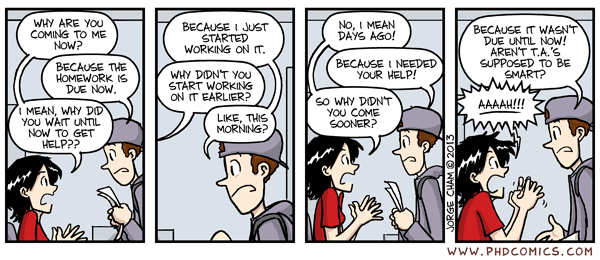
There is another type of loop. This is a stand alone, closed loop and it lacks vital logic clarity. These loops, called tautologies, are circular logic where the result is used to explain the cause, not fortify it. These loops have no start and no end. Here's a great example of tautology, a circular logic: 

(from the great site http://www.phdcomics.com, if you are in higher education as a student, staff or faculty I think you'll love their stuff)

Looking at it, seems to me that's there is something missing and that's causality. While the initial, intuitive, thought is that A is the reason for B and B is the reason for A, a through, logical consideration shows they are not connected. This is a logic mirage (jeez, I'm heavy into fantasy these days - sirens, mirages, the works).

Now, we all can succumb to tautology unintentionally, so we better be intentional.

If you have good examples of tautology, please share!

Saturday, May 4, 2013

Satisficing and the Siren's Song - Same or Different?

In a post about avoiding change I shared my experience and presented the concept of the "siren". I then recalled a much older post about Satisficing. At first there seemed to be a contradiction. I mean, how can I tell you not to fall for the spell of the siren while I'm the one telling you to be a satisficer? Seems like double standard, but it isn't. So, I figured clarification is in order.

First off, let's recall the overcoming resistance to change video, where change is basically compared to climbing a mountain to reach the "pot of gold". I'll use mountain climbing to explain my point, then. So let's agree that we set our goal to be climbing up a very tall mountain. Not a very hard mountain, no tricky technique needed, it's all just walking up a mountain. That's not to say it won't be hard. The elevation is high and there will be oxygen considerations, for example.We have defined what we want to achieve - we want to reach the highest peak of the mountain. our pot of gold is quite clear then, the sense of achievement.

Now that we have our goal set out and defined well we make a plan - we need to get in shape, train, learn the necessary skills, purchase equipment. There is stuff to be done, targets and milestones to achieve in the quest to the top of the mountain.

The optimizer will go into analysis paralysis quiet early in the process. This character will do a full research on everything - tents, sleeping bags, garments, training protocols. The need is to know what is the best of anything and everything. Time goes by and there is no progress because things aren't perfect. How can you start training if you don't know what is the best protocol and what is the best nutrition? When, at last, things do start happening they are slow because everything has to be perfect. You can't move to the next stage or the next piece of equipment until you get this stage or this piece just right. When climbing the mountain, anything but getting to the very top will be considered a failure for this type. Even if the "pot of gold" has been discovered, the peak must still be conquered, and an exhaustive search must be undertaken to ensure that the pot of gold is THE pot of gold and there is no other, better, pot.

The satisficer will move quite briskly through the paces. The targets are there for a reason and that reason defines the bar to achieve. So if a tent is called for, it's because sleeping out at night will be cold on the mountain, so a tent good enough for the expected temperatures is needed. Find out a good source of knowledge about tents, get an answer which is good enough for these temps and get a tent, on to the next task. Is this the best tent there is? Who cares, It is good enough, it'll do the job needed. Training will be handled much the same way. Each phase is there for a reason, a certain bar that must be attained. Once you reach that bar, the fact that more can be achieved is not a hurdle. The satisficer may try to improve the result, but it is not imperative so if there is time for more training it will be done, but if there is not, no problem. Then, on the mountain, this type will have a point where, having gone this far, finding a pot of gold, she will feel accomplished. So, while going all the way to the top is an appealing option, she will have no problem finishing the climb earlier if need be. When I prompt you to be a satisficer, this is what I'm talking about - go for good enough.

A person under the spell of the siren song will do nothing, no preparation, no training, no climbing. This person will want to reach the summit, will envy those who do and even those who try. Still, nothing will be done. The current situation seems safe and comfortable. So even though there is a desire, no effort is put forth, not even a little try, one that comes at basically no risk. No looking at equipment, no training that's good for your health anyways. Nothing. Not even climbing a small hill, just for fun. This person is stuck in the "comfort" of the bland current situation - settling for far less than possible.

It is clear now that the satisficer is not under the sirens spell. The satisficer makes change happen and balances effort with reward, leaving the optimizer and those listening to sirens song far behind.

I have more ideas on this subject but first I'd like to know can you relate to this? let me know what you think and subscribe to get more post from this blog.

Monday, April 29, 2013

Sugar bag logic - teaching children to think

My younger son, who is eight, and I sat in a coffee shop for breakfast today. As we were waiting for our food, I figured I might as well make some use of the time we had together. I had wanted to start working on logical thinking with him for quite some time but I never got around to it. My plan, of course, was to do something structured, maybe use the children's' workbooks I got at the Goldratt House. Well, I know that if you fail to plan you plan to fail. There's another part that's always left out. That is that even if you plan you may fail, but fail to execute, and you will absolutely, no doubt about it, get nothing done.

So back to the coffee shop. I decided to wing it. I told him that I know he'd like to be a scientist (he actually means inventor, but I won't be petty), so I'd like to present to him the most important tools for such a vocation. The tools are experiments and logic. Happy to make conversation with me, he told me right away that logic is an important part of his life, since whenever something doesn't make sense he works to fix it. That threw me off a bit so I inquired into it and, as he was finding it hard to explain himself, I requested an example. That was easy. He told me how one of the characters in his computer game seemed to have more than the fare share of something, so he investigated until he found out the details he was unaware of and realized the rules were adhered to.

That was not quite what I had in mind, but you do not want to go around putting your kid down, so I kept my thoughts to myself as much as I could. There is a more basic tool in logic, I told him, and that's the understanding of what causes what. That drew quite a blank stare from him.Good start. So I took a few bags of sugar from the dispenser and I put one down saying: "If you vex your older brother then...", I put the next one after it and he jumped in and said "I get punished". "Not quite, we aren't there yet, though it could lead to that" I say, "this process is like a ladder, you can't skip steps and you want to take small steps to feel secure". I go back to the small bags of sugar "If you vex your older brother then", the second bag of sugar goes down, "your brother gets annoyed, and if your brother gets annoyed then...", another sugar bag is added to our trail, "your brother retaliates, and if your brother retaliates then", another bag, "you get upset, and if you get upset then", another bag and he picks up, "I beat him up". Now we are working as a team, "If you beat him up then?", I put another bag down and he finishes up "I get punished".

"It's like your dominos, Mom", he says. Whenever their quarrels heat up and require parental intervention I use the domino effect to explain why I think they are both to blame. You each had multiple chances to stop this from escalating, I tell them, all you had to do was take 1 domino out. So, he was right, my trail of sugar bags did resemble the domino effect. Ah, the glory of true understanding. We managed to do a couple of AND conditions ("If we quarrel" AND "Grandma finds out" THEN "Grandma is not happy with us" - his example) and then the food was ready.

So, here's what I found out this morning, while waiting for breakfast at a coffee shop: That learning doesn't need a classroom, a format or even much time, that children can grasp logic very easily, that logic is pretty simple to start off with and that small bags of sugar make great entities in a logic diagram.

Have you ever tried to get your kids to think logically? well, that's probably the worst time to teach them. Take 10 minutes when everything is calm to set the stage and plant the seeds for the future.

If you liked this post, please share it with other parents and comment with your own experience. 

Saturday, April 27, 2013

Stop waiting - ask and you shall recieve

I've always wanted a mentor. You could say I have a father figure issue and I'd be the first to agree but it's not relevant. I've recently figured out that in the Theory of Constraints you may learn from the past but other than that you basically let it be gone. It doesn't make much difference how you got to where you are, the thing that's really relevant is how to get to where you're going. So, as I was saying, I've always wanted a mentor.

After I began writing in the TOC groups and in this blog I, subconsciously of course, started a waiting game. I was waiting for someone to pick up a cue of my need, step forward and offer to help me. Impudent, I know (oh, the wonders of retrospect), but I was terrified of asking. Why? basically a whole load of excuses, no real valid reason. I just felt I had no right, it wasn't polite and that kind of hogwash. I told you all I have are excuses. The only thing I can say is I was afraid of consequences without putting a moments thought into why.

Another thing I realize in retrospect is that I have been offered the help I wanted many times in the past. Thing is, just as my requests were not straightforward so were the offers. I was weary of asking straight out in case I would offend someone or be turned down. In much the same way the people who were reaching out to me did not state it straight out, probably in order to make sure not to offend me if they misunderstood. Well, I hope I'm done with playing that kind of immature game. Better late than never. This doesn't change the facts, though - I was stuck, not in a very good place and I was not liking it. Still, I waited. Still, I was afraid to change anything.

When I look now at Goldratt's 4 quadrants of change, I guess I was under the spell of "The Siren". Do you remember that, in some sea going folklore, sirens are mermaids that tempt the sailors and then drawn them?
Well, as I see it, this holds true in daily life as well. The "siren" is that comfortable settling for less, the place where fear of change glorifies the current situation way beyond its truthful value and at the same time vilifies the risks of change to the extreme. When the "siren" sings, the minuscule risk of getting a negative answer that will simply leave things as they are (=nothing to lose, no?) will seam unbearable, best leave things as they are and not risk it.....

There is a parable going around email kingdom. It is about a guru that forces his student to kill the only cow of a poor family. When the student returns, full of guilt, to right the wrong he has done at his guru's bidding, he finds the family became reach. The family explains that when they had the cow and it gave a little milk, they made do with what they had. One day the cow died and they could no longer make do, they had to figure out another way and when they did they realized they could do so much more and have so much more. So sometimes we are forced out of the spell of the siren, someone comes along and "kills" our "cow". That does not happen often.

My claim is that we should not let the spell of the siren control us. We should not wait helplessly for others to come and free us. If ever we are paralyzed by the idea of change or of taking a risk, if ever we encounter a rejection to a change we offer that seems to come from a place of paralysis, we need to use our logic, the analysis tools and a little courage and break free.

So I want to thank Jim, Lisa and the others for offering so kindly to help me out. Thanks Jim for all the help and for leading me to success. It was a lot of hard work but it was not hard as I made it out to be!!!

Have you ever struggled to overcome the siren? Please share your experience. Do you know someone still under the spell? Please send them this post.

Friday, April 5, 2013

What SEO practices reveal about Theory Of Constraints

[Disclaimer - this post does not address SEO how to. To learn SEO - follow my affiliate link and view the offer there]

Intro (skip this paragraph if you'd like to get right to business, it's the background story)
It's funny how things roll about. I am a bit obsessive about this blog's statistics (I'm an Industrial Engineer by nature - I obsess about all my graph-able data), so I noticed when a new referral URL showed up on my list and went over to check the site, maybe there's some new Theory of Constraints content for me to enjoy and share. Well, what I encountered was a total surprise. It was a 1-page static site built in Blogger in order to promote a "get rich blogging" offer. Seems the owner encountered my blog and liked it, so she linked back to it. I am, of course, much obliged. And so I came face to face with this offer to get all the inside info of making money by blogging. As you can see, I am not ashamed to admit I'd like to make a bit of extra padding from this blog, so the offer sparked some interest in me. Normally, though, I would brush these kind of offers to the side, assuming they were aimed at making someone else rich... I know not what was different this time, other than the very low risk associated (1$ for the first 7 days), but I decided to risk it. I enrolled to the website and started looking over the information it offered. It was a complete, step-by-step guide to building marketing blogs to create affiliate income. I liked what I saw and decided to stick around there for a bit and even became an affiliate of his offer (you can find more info through my affiliate link, please note I have no plans to promote it in this blog, this is just FYI). Going through all the SEO (Search Engine Optimization) techniques and trying to apply them for Theory Of Constraints I started seeing some disturbing patterns. After some more research here is what I've come up with.

The Facts
Almost a year ago to the day, in this post, I pointed out that the interest in Theory Of Constraints is on the decline. Well, there has been no improvement since then, as this graph shows clearly:

Note - the number 100 represents the peak search interest.
Before I went off to dig deeper I checked if there is any search term predominant within the Theory Of Constraints world and this is what I got:

All things Theory Of Constraints are more or less equal in the interest they have been generating in the last few years.
Using the analysis tools over on Google's Adwords website, I found that 'Lean Six Sigma' generated 800 keyword combinations. Of these, over 200 combinations that are in high demand for PPC (Pay Per Click) campaigns and over 300 combinations are searched 6,500 times a month or more. Using the same analysis for all the Theory Of Constraints topics combined I generated only 100 keyword combinations. No combination was in high PPC demand and the top 8 most searched combinations were either not relevant (they were actually relevant to lean six sigma) or suspected as such. Running a Google search on "Lean six sigma" yielded 19.5 million results. Running a Boolean OR search containing the words "Goldratt", "Goldratt the goal", "Theory of Constraints", "Critical Chain" and "Thinking Process" yielded 26.8 million results. I also did a few searches of  global terms that could be relevant to Theory Of Constraints such as "process improvement" or "project management" and there is no Theory Of Constraints content to be found in the results, paid or natural, in the first few and critical pages.

My Thoughts
Assuming the internet, as reflected by Google, is a good representation of reality then, clearly, the information is out there. Not so many are interested in it and, it would seem, no one is trying to generate the interest. This leads me to the assumption that the Theory Of Constraints community has become a closed community. This means that even if we, as a group, are happy and willing to accept new comers the group is still experiencing a "negative birth rate". Which is weird, since Theory Of Constraints practitioners are not working in the community, they are distributing the knowledge to companies outside this tight knit group. Perhaps that explains the leveling of the interest visible in the graphs from 2009 to the present. I have no answers here, I just know what the data is showing and I'm trying to relate this to the reality I am encountering.  So, yes, newcomers are accepted happily but they are aliens, which feels weird and uncomfortable, leading them to opt out.
Should this trouble the Theory Of Constraints community? I think it should but is it my prerogative? If we, as a community, want to change this around, we should, of course, do that by using the TP tools. After all - we all want to practice what we preach. I can't decide for the whole community, so, just for now, I'll leave it at that and only share my basic intuitive reactions, perhaps they will come in handy in the future. First, is the need to regenerate wide interest, which requires we look at Theory Of Constraints through the new audience's eyes, with the inevitable conclusion that we must and stop using our jargon when talking to them. Second, to my humble opinion, is the need to create a multiple stream of smooth and easy processes that lead from laymen to proficient. My personal experience shows that every time I look for ways to progress I find that, other than self learning everything (with or without a mentor), almost everything is either too basic or aimed at specific populations such as top managers and therefore at such a premium I can't afford  Why aren't there mid-way options?


Conclusion
This was a hard post to write. Not because it required research and analysis, but because I'm stepping out of my comfort zone. I am posting this knowing that some who may read it will not agree with me, that some may feel hurt or angry. While I tend to shy away from such uncomfortable situations, I decided that, since Theory Of Constraints is important to me, this is worth putting out in the open. Please feel free to comment or reply to me privately with any piece of information that I may be missing. I'd love to come back here just to say I was wrong.